
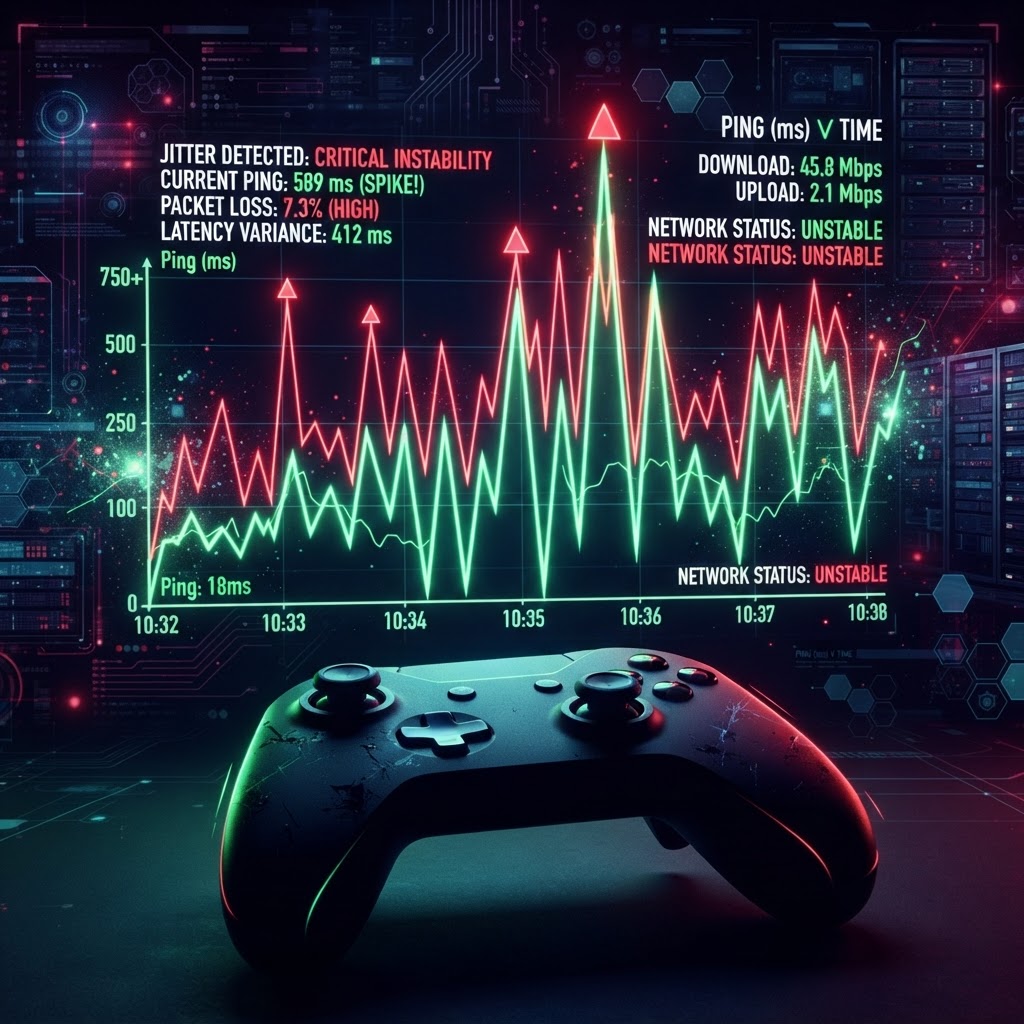
Everyone talks about ping. Almost nobody talks about jitter. But jitter is the reason your character sometimes teleports, why your abilities register a half-second after you press them, and why some nights just feel off even though the speed test looks fine.
Jitter is the variance in your ping over time. A connection with an average ping of 40 ms sounds great. But if that ping is bouncing between 10 ms and 90 ms every few seconds, the game engine cannot predict where you or anyone else should be. It tries to smooth things out with interpolation, and the result is the rubber-banding, hit registration weirdness, and delayed inputs every online gamer has cursed at.
Fiber-optic connections tend to have the lowest and steadiest jitter because they are less affected by neighborhood congestion and electrical interference. Wi-Fi, on the other hand, is a jitter machine — walls, microwaves, and even Bluetooth devices push your latency around unpredictably. If jitter is the piece of the puzzle you never really understood, this Ziply Fiber deep-dive on speed, latency, and jitter in gaming is one of the clearest explanations available.


