
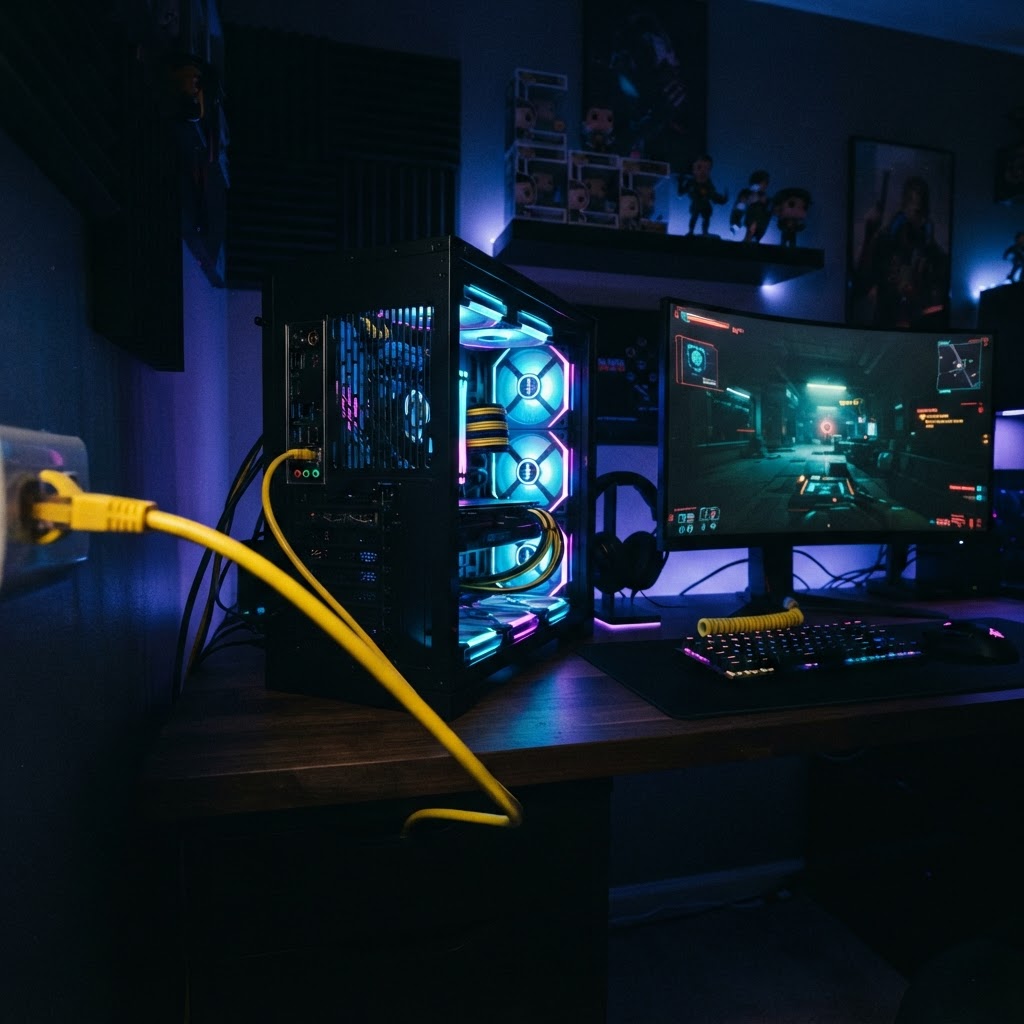
You just dropped $800 on a new graphics card. You expect to boot up your favorite shooter and dominate the lobby. Instead, you get shot from behind by an opponent who was not even on your screen a half-second ago. The GPU is not the problem. Your internet connection is.
Online multiplayer games are not really a graphics test. They are a race to send and receive tiny packets of position and hit data faster than the person you are trying to shoot. When you press a key, your input has to travel to the game server, get processed, and come back with an updated world state. If any part of that round trip is slow, jittery, or drops packets, you lose fights you should have won. A top-tier PC on a mediocre connection performs worse than a mid-range PC on a rock-solid one.
The good news is that fixing this is cheaper than a GPU upgrade. A fiber or cable plan with symmetric or near-symmetric speeds, a wired Ethernet run to your rig, and a router built for gaming traffic will usually deliver more visible improvement than another hardware upgrade. If you want a deeper breakdown of exactly how bandwidth, latency, and jitter show up on screen, this write-up on the impact of high-speed internet on online gaming experiences walks through it with clear examples.


